What an HR-driven joiner mover leaver process means
An HR-driven joiner mover leaver process treats the HR record as the authoritative source that decides when an identity starts, when its access changes, and when its access is removed. In SailPoint Identity Security Cloud (ISC), that decision moves through the authoritative source, an identity profile, and a Lifecycle State attribute.
Joiner, mover and leaver (JML) describe the three identity events every organization runs: a new worker needs access, a worker who changes role needs access changed, and a worker who leaves needs access removed. Identity and access management (IAM) makes those changes happen in the systems people use. Human resources (HR) is usually the first system to know they happened.
The difference between a process that works and one that drifts is who carries the decision. A ticket-driven process depends on someone remembering to file the request. An HR-driven process lets the employment record carry it.
It is written for the CISO or compliance officer who owns the risk, and for the IAM engineer who builds the control.
Why joiner mover leaver processes break
The cost of a broken JML process shows up in two places. The first is access that outlives employment. Standards that govern access treat termination and access changes as defined control areas. The frameworks this design contributes to are listed in the controls section below.
The second is proof. In GCA's experience, ticket evidence means screenshots. One shows the account before it was removed or disabled, another shows it afterwards, and both are attached back to the ticket. The system time has to be visible in each one, or the evidence is weak. Gathering that set when an auditor asks is tedious and difficult. When an assessor asks who removed a former employee's access, and on what date, the answer should come from records, not memory.
The design decisions that matter
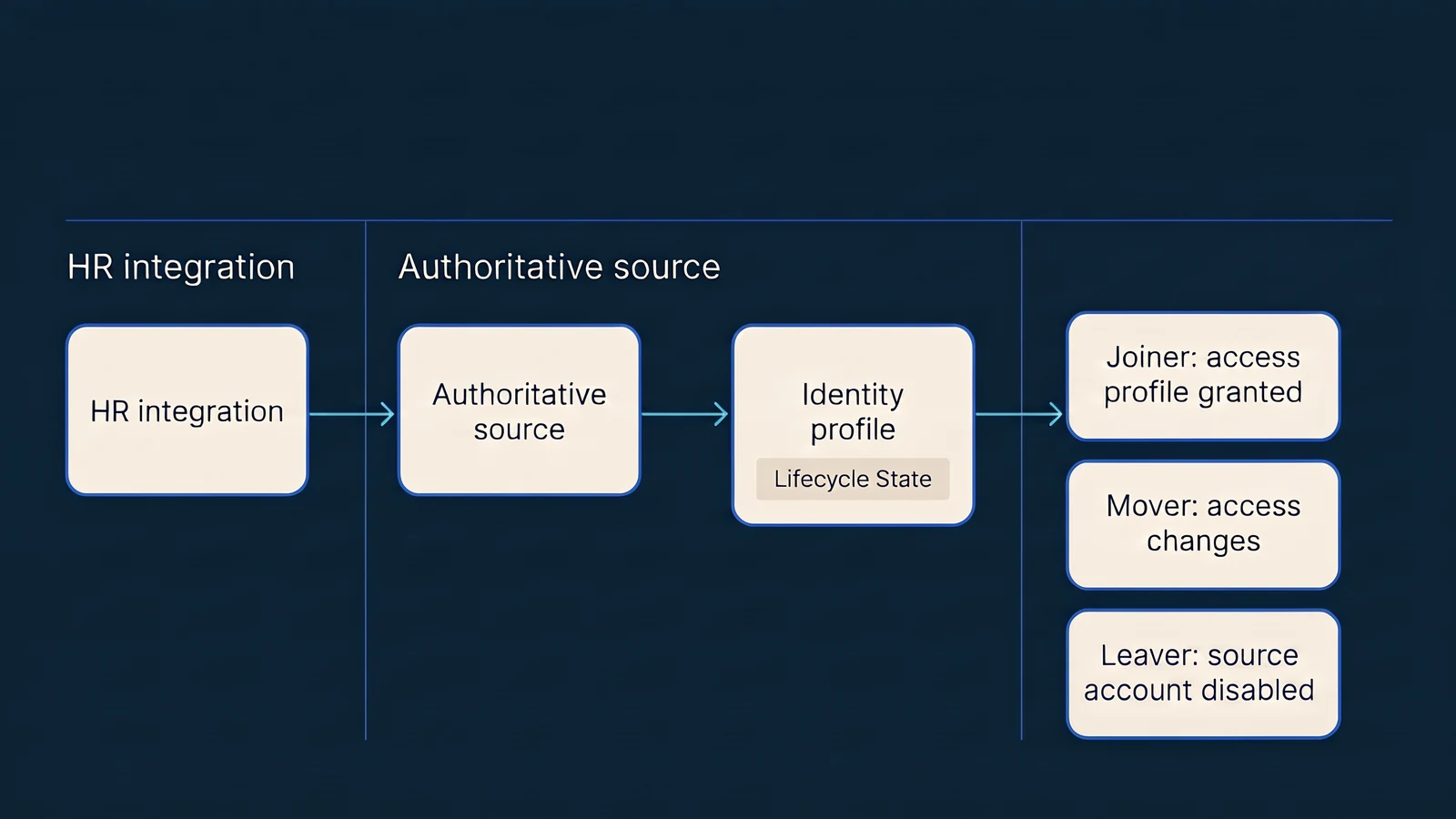
Everything downstream depends on the HR record being right. GCA's approach treats HR as the authoritative source for identity status, and no platform configuration corrects a termination date that the authoritative source gets wrong.
Where HR controls the trigger, there is a second-order consequence we see often. In GCA's experience, an error on the HR side shows up as an operational incident: a person's accounts are disabled because HR said to turn them off. The identity system did exactly what it was told, so the trigger has to be reviewable before it acts, not only after. Five decisions shape the design.
- One authoritative source per identity. An identity can be associated with only one identity profile, so no worker is governed by two HR sources at once. We prefer direct integration with HR, such as an API or a database view, over a periodic file.
- Map the lifecycle attribute. Automatic lifecycle state assignment depends on the Lifecycle State attribute being mapped. Values are matched case-sensitively, so "Terminated" and "terminated" are different values.
- Let lifecycle states own status-driven changes. A state can enable or disable accounts, grant access profiles, or remove all access. Access granted by a state is revoked when the identity leaves it, unless the new state also grants it. That allows the leaver path to proceed without a separate ticket.
- Keep provisioning off until the preview is right. New sources are read-only by default, and provisioning must be enabled deliberately. Our recommendation is to keep a source read-only until previews match expected results.
- Configure correlation before the first load. The documentation's guidance is to configure correlation before the first aggregation, because uncorrelated accounts must be resolved before their identities can be granted access.
The mover problem
A mover is the easiest case to get wrong, because the worker's status does not change. The department or manager changes, and access has to follow.
Legacy identity governance tooling and processes often revoked everything and reprovisioned for the new position. That optimizes away the overlapping access, but it is rarely clean for a real mover. Job responsibilities do not change on the day the org chart does, so the business waits while access is rebuilt.
The opposite failure is entitlement creep, where access accumulates across moves and is never removed. The design goal is to reduce creep while supporting a transition period.
This is GCA's design approach, not a documented feature of SailPoint Identity Security Cloud. When a mover changes position, the design triggers a review of the access the new position would revoke. The reviewer can retain that access for a limited, defined period so responsibilities can be handed over. Retention is subject to separation-of-duties rules. If there is no response, the access is removed.
The leaver problem: timeliness is the exposure
A leaver who keeps access after the exit is the failure a termination control exists to prevent. Former workers who can still reach systems hold access with no remaining reason. The frameworks that address termination are listed in the controls section.
For audit, the question is rarely whether an account was eventually disabled. It is how long the access survived after the exit, and whether anyone acted once the exit was known. Late access removal is a common area of assessor testing.
Termination can be late before it reaches the identity system. The authoritative source may hold a termination date that is already in the past when it arrives, and an auditor looking only at identity records may conclude that access was disabled late. The question that matters is whether the organization acted promptly once the termination reached it. Often the breakdown is upstream, in HR, and the evidence should show where.
Design principle: retain timestamps for each leaver. Record when the termination was received, its effective date in the authoritative source, and when the access change was actioned. Together they show what the organization knew, when it knew it, and what it did. This supports demonstrating timeliness. It does not by itself satisfy any requirement.
A worker who simply drops out of the HR feed is a related gap. GCA's approach is to require an explicit terminated status and to treat a missing row as an exception to investigate.
Impact analysis before every new source
GCA recommends a full impact analysis before you add any source, authoritative or downstream. ISC provides per-identity preview. In GCA's experience it does not report every change across the population before a connector is enabled. GCA uses its own processes and helper utilities to report the changes that would be made before a connector is fully enabled. The report catches problems such as:
- Attribute changes, such as a preferred name reverting to the legal name from HR.
- Access revoked that does not align with the role model.
- Business processes not followed, or undocumented exceptions that requirements gathering missed.
In GCA's experience, organizations have accidentally revoked access for significant populations of users. Impact analysis is designed to surface those changes before they impact operations.
Testing is where identity programs quietly fail
Testing is the part of an implementation that organizations most often underspend, and it decides whether the design holds. Four failure patterns recur.
- Thin impact analysis. Preview before enforce shows what would change. Many teams preview only the records they expect to change.
- Pristine scenarios only. Negative tests show what happens when something unexpected arrives. Without them, the outcome is unknown.
- Regression debt. Every change needs proof that nothing else broke. Without automation, regression testing grows until it slows the team's ability to add functionality at all.
- Corner-case fixes that become manual steps. A fix that is hard to validate tends to be performed by hand every cycle, and the effort accumulates.
Budget is often the reason testing is thin. More testing adds cost, and the risk-reward case is hard to make for a test that might find nothing. In GCA's experience, AI assistance can lower the cost of broader testing. It helps generate test data, test cases and deterministic scripts that execute and evaluate the tests, so more JML operations can be tested thoroughly rather than only a few smoke tests. GCA's approach is for engineers to run the generated scripts in a lower environment before production. The AI does not run or judge the tests: the deterministic scripts execute and evaluate them, and engineers review the results. Idempotency belongs in the same test set.
The evidence the design produces
A correct configuration is only useful if it leaves records an auditor can read. A run of this design should produce:
- Identity preview output for each change, with the expected lifecycle state and access profiles for each worker.
- The load result for each HR data load, with row counts before and after.
- Enable and disable records, with the lifecycle state that triggered each one.
- Leaver timestamps: receipt of the termination, its effective date, and the access change.
- Mover records, including the outcome of each retention review.
- Correlation results, with each uncorrelated account and its named owner.
- Negative test results, with pass conditions and observed results.
Known limits
- Account deletions are processed only in full aggregations, and only where account deletion is enabled on the source. If more accounts than the configured threshold would be deleted, the aggregation is canceled with a warning. In GCA's design, plan removal timing around your full-aggregation schedule.
- Single-account aggregation does not synchronize identity attributes. Plan full loads for identity-level changes.
- SailPoint documents that search results can take up to 24 hours to reflect some updates.
Controls this contributes to
This design contributes to the controls listed below. It does not satisfy them. Whether a control is met depends on the environment, and an assessor makes that determination. The mappings reflect GCA's practice judgment and are not an assessor's determination. Each framework name links to its GCA page, and each control ID links to its row on that page.
Several HIPAA implementation specifications listed here, including 45 CFR 164.308(a)(3)(ii)(C) and 164.308(a)(4)(ii)(C), are addressable under 45 CFR 164.306(d)(3). The covered entity or business associate assesses whether each is reasonable and appropriate in its environment. If so, it implements the specification. If not, it documents why and implements an equivalent alternative measure if reasonable and appropriate. Addressable does not mean optional.
Where IAM Implementation Services fits
This design is the configuration side of an identity implementation, and it produces the audit evidence. GCA's IAM Implementation Services can carry it into a production tenant. Engagements typically address HR data quality, identity profile design, lifecycle state design, impact analysis, testing and cutover. GCA calls this the Implement phase of its Assess, Implement, Manage method.
Check your own posture
Five questions show whether an HR-driven lifecycle is working or only configured:
- Can you name the authoritative HR source for every identity in your tenant?
- Does each identity map to exactly one identity profile?
- Do your HR lifecycle values match the lifecycle state technical names exactly?
- Do you preview identity changes before you apply them?
- Can you list every uncorrelated account this week, and say who owns each one?
If you cannot answer all five, talk with us about IAM Implementation Services. Start Your Implementation
After go-live, GCA's Managed IAM Services covers ongoing identity operations.
For the control mapping behind this article, see the compliance hub. For the SailPoint work GCA does, see the SailPoint partner page. For the governance side of the same access decisions, see identity governance.